

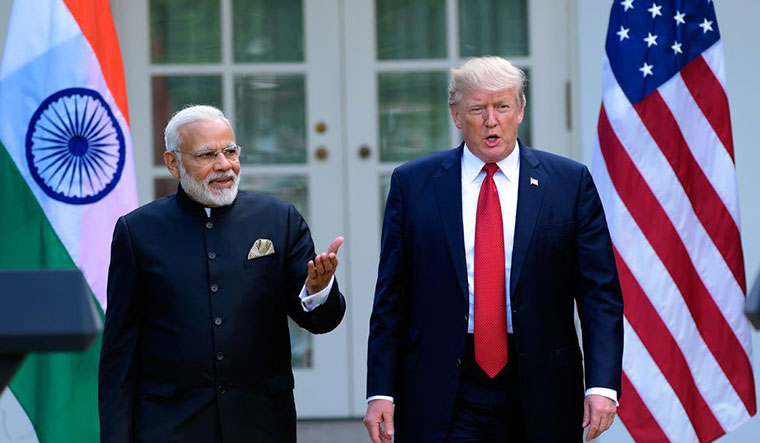
Modi and Trump heaped praise on each other in a joint appearance at a Houston stadium during Trump's first term in 2019, touting a close, personal alliance in front of tens of thousands of Indian-Americans. Even though Trump occasionally aggressive posture towards New Delhi in his first term, India as a "tariff king" and "trade abuser".
Lacking of good understanding with x president Biden in last tenure, Mr. Modi has prayed and expected to Trump empowerment. In this tenure the inter Country relationship has changed to various reasons. Such as economic, Trade, Business, Defenses, Military alliances, war in Gaza & Ukraine, Europe & America opposition alliance’s etc. Therefore, relation of India an USA most valuable topics over the world.
Donald Trump, during his campaign for the 2024 U.S. presidential election, pledged to impose stricter measures on various fronts if he returns to office. These pledges have focused on areas such as immigration, trade tariffs, crime control, and international relations, and they reflect some of the policies he advocated for during his first term from 2017-2021. Key aspects of his pledges include:
1. Tariffs on Foreign Goods:
- Trump has promised to impose sweeping tariffs on foreign imports as part of a broader “America First” economic policy. His proposed tariffs would aim to reduce the U.S. trade deficit, bring manufacturing jobs back to the U.S., and reduce dependence on foreign countries, especially China.
- This policy could affect U.S. relations with countries like India, whose goods could be subject to tariffs, potentially impacting trade and investment dynamics between the two nations.
2. Immigration Restrictions:
- Trump has pledged to impose stricter immigration policies, which could include more extensive border security measures, limiting asylum claims, and reducing pathways for legal immigration. This includes revisiting policies for work visas, such as the H1B visa, which is popular among Indian workers in the U.S.
- A reduction in H1B visa issuance could impact the U.S.-India tech relationship, given the large presence of Indian professionals in the U.S. tech industry.
3. Countering China’s Influence:
- Trump’s proposed tariffs and foreign policy adjustments include a strong stance against China, with potential new restrictions on Chinese companies and products. His approach would aim to curb China’s economic influence and address trade imbalances.
- This hardline stance could indirectly strengthen U.S.-India ties, as India is viewed as a critical partner in the Indo-Pacific, countering Chinese influence. However, it could also lead to pressure on India to limit its economic and defense ties with China.
4. Tougher Crime Policies:
- Trump has pledged to impose stricter federal crime policies, targeting drug trafficking, organized crime, and urban violence. He has proposed bringing back certain federal crime measures, including potential military involvement to control violence in areas heavily affected by drug cartels and criminal organizations.
5. Energy and Climate Policy Shifts:
- Trump has pledged to increase domestic energy production, focusing on fossil fuels like oil, natural gas, and coal. This policy shift would likely lead to a rollback on climate change initiatives established under the Biden administration.
- Such shifts might limit collaboration with countries like India on climate and clean energy initiatives, potentially affecting joint goals for carbon emissions reduction and green technology innovation.
Trump’s isolationist foreign policy and Modi’s pro-business stance provide a complex backdrop for India-US relations. Trump’s focus on minimizing US involvement in international agreements contrasts with Modi’s vision of a globally engaged India.
Possible Implications for U.S.-India Relations
If these pledges are implemented, they could lead to complex interactions between the U.S. and India. The U.S.-India relationship has been increasingly strategic and multifaceted, with both nations finding common ground on several key issues such as Tariffs on Indian goods, stricter immigration policies, and a reduced emphasis on climate action could strain parts of the bilateral relationship. Shared interests in countering China's influence and bolstering defense ties may continue to keep U.S.-India relations strategically significant, security regardless of these changes. Here are some potential implications and areas of interest in this relationship:
1. Tariffs on Foreign Goods:
For India, increased tariffs could challenge industries like IT, pharmaceuticals, and textiles that rely on the US market. If Trump pushes for decoupling from China part of his previous economic strategy, it could benefit India, potentially drawing more US investment into its manufacturing sector. China has emerged as India's largest trading partner in the FY 2023-24 with $118.4 billion two-way commerce, narrowly edging past the US, according to the data of economic think tank GTRI. The bilateral trade between India and the US stood at $118.3 billion in 2023-24.
2. Immigration Restrictions:
if the two leaders manage to find a compromise on immigration, it could mark a new chapter in India-US collaboration. India remains one of the largest sources of skilled labor for the American tech industry, and a favorable policy approach could ensure continued synergy between both nations’ tech sectors.
3. Defense and security in the Indo-Pacific
India-US defense ties have grown significantly in recent years, especially with moves like the Initiative on Critical and Emerging Technology (iCET) and major defense deals. The Quad was elevated during Trump’s first term as a counterbalance to China. In a second Trump term, further emphasis on Quad initiatives could reinforce India’s role as a key player in maintaining stability in the In do-Pacific region. By enhancing military cooperation, the US and India can jointly address China’s assertive policies, underscoring their commitment to a free and open Indo-Pacific.
4. Climate Change and Sustainability
Joint Climate Initiatives: Both the U.S. and India are investing in renewable energy and emission reduction targets. Joint commitments, especially under frameworks like the International Solar Alliance and Mission Innovation, can enhance the impact of climate policies and promote sustainable development goals.
If Trump 2.0 can find an end to the two ongoing catastrophic wars, New Delhi could greatly benefit as well.
In the years ahead, Modi and Trump could focus on finding equilibrium. Time will say how much more they can do?
